

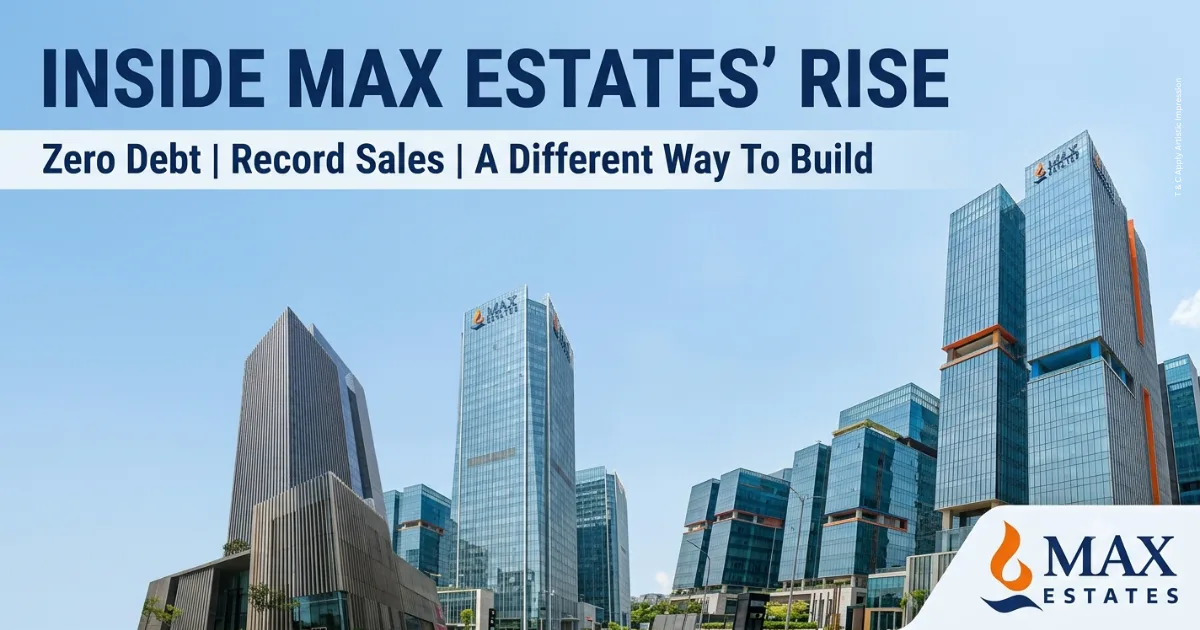

Most real estate developers grow the way most businesses grow borrow, build, sell, repeat. Max Estates has spent the last few years trying to prove there’s another way. No debt on its residential book. Construction funded almost entirely by what buyers have already paid. And a bet that “wellness” isn’t just a marketing word, but something buyers will actually pay a premium for.
We have gathered some information here.
The Zero-Leverage Strategy
For most developers, leverage is the default tool for scaling. Max Estates has deliberately avoided that path on its residential side, choosing instead to fund construction through collections the money that flows in as buyers pay their installments.
That approach only works if sales keep coming in strong, and recently they have. Collections in fiscal year 2026 reached roughly Rs. 1,578 crore, up around 61% year-on-year. That inflow has been enough to keep residential projects moving without new borrowing a rare position in an industry known for stretched balance sheets and delayed handovers.
Record Sales, One Project at a Time
The clearest evidence of demand came from a single launch. Estate 105, a low-density residential development in Noida‘s Sector 105, brought in roughly Rs. 1,783 crore in sales within ten days of its March 2026 launch. The project’s first phase alone is projected to reach a gross development value of about Rs. 3,000 crore across its 10+ acres a scale that made it one of the standout launches in the NCR market this year.
That single project helped push Max Estates’ full-year pre-sales to around Rs. 5,305 crore for fiscal 2026, one of its strongest years since entering the residential market.
A Different Way to Build
What separates Estate 105 and Max Estates’ residential portfolio more broadly isn’t just the sales numbers. It’s the design brief behind them. The company builds around what it calls its “Live Well” philosophy: low-density layouts, large amounts of open green space, and amenities aimed at physical and social well-being rather than just square footage. Estate 105 arrived with IGBC Platinum pre-certification and biophilic landscaping built into the plan from the start, rather than added on afterward. The same thinking shows up on the commercial side under a parallel “Work Well” philosophy. Office assets like Max Towers and Max Square have reportedly maintained full occupancy, and the company has landed pre-leasing deals in Gurugram and Noida at premiums to their local markets including a large office lease from Adobe at Max Square in Noida.
The Trade-Offs Worth Naming
A company that does not have any debt and uses money from buyers before building has an advantage: it protects the company from going bankrupt like other developers have.. This model also has its own problems. Growth depends on selling more properties. If a new project does not sell well the company does not have money to fall back on. This has been a challenge for Max Estates. Even though the company has been selling a lot of properties it made profit in a recent quarter compared to the same time last year. The company’s stock price has been low. Investors think it is overpriced compared to other real estate companies like DLF and Godrej Properties. Some investors even changed their recommendation from “Hold” to “Sell” in 2026. Max Estates had to wait nine years for permission to build its Max One project. It finally got approval in March 2026. None of these problems change the fact that Max Estates is selling a lot of properties. It just means that its new way of building is still being tested, not on the construction site but also, on its finances. Max Estates is still proving if its model works.
The Bigger Picture
Zoom out. It seems like Max Estates is taking a risk. They are focusing on growing in an debt-free way and they are also designing their properties with wellness in mind. They are betting that this approach will be more successful than developers who are growing quickly but using borrowed money. The area of Noida is on the rise, with a new airport coming in Jewar more roads being built and more companies moving in. This is helping Max Estates approach look good. Now the question is, will this approach still work as Max Estates keeps growing?. Will the financial pressure get too strong and make them change their plans? It’s something to keep an eye on for the rest of 2026.


Leave a Reply